
Concrete & Driveway Services
25 years of residential concrete work across Chicago’s western suburbs.
I’ve spent 25 years doing one thing: residential concrete work across Chicago’s western and northwestern suburbs. Driveways, patios, sidewalks, garage floors, stoops, and decorative flatwork — if it’s concrete and it’s at someone’s house, I’ve poured it. This guide covers what we do, what it costs in 2026, and what you should know before hiring anyone to work on your concrete.
🚗 Driveway Replacement
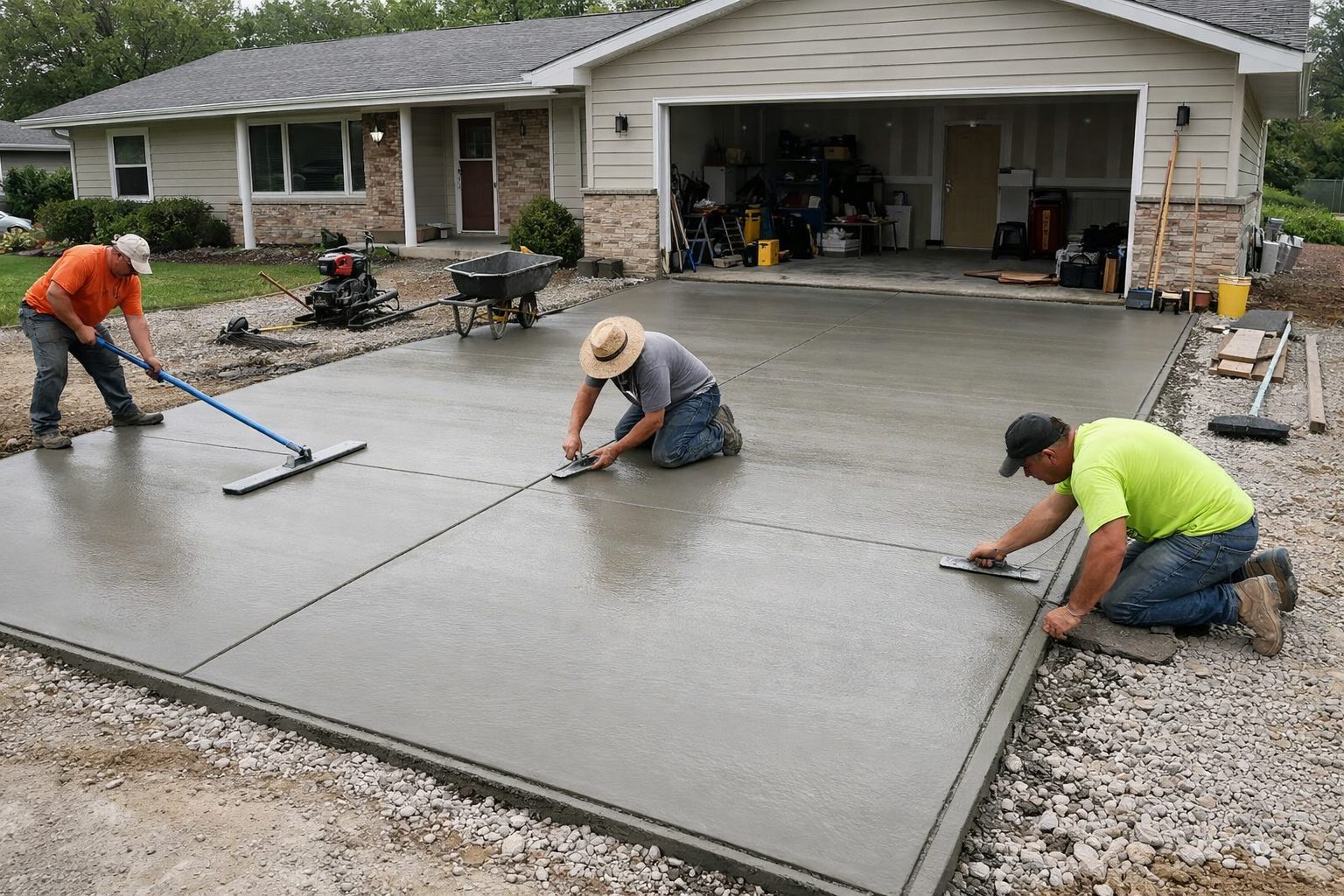
Driveway replacement is the most common concrete job in the western suburbs, and for good reason. Most driveways out here were poured between the 1970s and 1990s, and after 25–40 years of Chicago freeze-thaw cycles, they’re past their service life. Heaving, cracking, scaling, and settlement are all signs that patching won’t cut it anymore.
A standard two-car concrete driveway replacement in the western suburbs runs $7,200–$12,500 in 2026. That includes tear-out of the existing slab, haul-away, excavation to proper depth, 6–8 inches of compacted CA-6 aggregate base, 4-inch minimum concrete at 4,000 PSI with 6% air entrainment, fiber mesh reinforcement, control joints at proper intervals, and broom finish. Decorative options like stamped or colored concrete push the range to $12,000–$18,000+.
The base preparation is where your money either works for you or against you. DuPage and Cook County sit on heavy glacial clay that expands, contracts, and heaves with moisture and temperature changes. Skip the proper aggregate base and your new driveway fails within 5–8 years. Pay for it right and you’re looking at 25–30 years of service.
Related guides: Driveway Replacement Cost in Addison, IL · Concrete vs. Asphalt in Hoffman Estates
🧱 Stamped & Decorative Concrete
Stamped concrete has come a long way from the early days when everything looked like fake brick. Modern stamping techniques can replicate natural stone, slate, flagstone, wood plank, and dozens of other patterns with impressive realism. And unlike pavers, there are no joints for weeds to grow through and no individual pieces to shift or settle.
In the western suburbs, stamped concrete typically costs $15–$28 per square foot installed — roughly 40–60% more than standard broom-finish concrete. The price depends on the pattern complexity (ashlar slate is simpler than European fan), the number of colors (one base color with release is cheaper than integral color with accent staining), and the size of the pour. Larger areas bring the per-square-foot cost down because the stamp setup is the same whether you’re doing 200 or 800 square feet.
One thing I always tell homeowners: stamped concrete needs to be sealed every 2–3 years to maintain the color and protect the surface from Chicago’s road salt and freeze-thaw. Budget $200–$500 per application depending on the area. It’s not a lot, but it’s not zero maintenance either — and some contractors conveniently forget to mention this.
🔧 Concrete Repair & Resurfacing
Not every concrete problem needs a full replacement. If you’ve got isolated issues — a settled slab section, minor surface scaling, or hairline cracks — repair is often the smarter play both financially and practically.
Mudjacking / foam leveling ($500–$2,500): For slabs that have settled or tilted but aren’t cracked. Polyurethane foam injection (the modern approach) costs more than traditional mudjacking but lasts longer and doesn’t add significant weight to the already-struggling soil underneath.
Crack sealing ($200–$800): For cracks less than 1/4 inch wide. Proper crack repair uses flexible polyurethane or silicone caulk that moves with the concrete through temperature changes — not the rigid stuff from the hardware store that pops out after one winter.
Concrete resurfacing ($3–$8 per sq ft): For driveways with widespread surface scaling or spalling but structurally sound slabs. A polymer-modified overlay bonds to the existing concrete and gives you a fresh surface. Not a permanent fix — figure 8–12 years — but it buys time at a fraction of replacement cost.
When repair doesn’t make sense: If more than 30% of the surface is damaged, if multiple sections are heaving at different heights, or if the slab is 25+ years old and showing its age everywhere, replacement is the better investment. Spending $3,000 on repairs to a driveway that needs $10,000 in replacement is throwing good money after bad.
🏠 Garage Floors & Interior Flatwork
Garage floor replacement is a project most homeowners don’t think about until the floor starts crumbling. In the western suburbs, original garage slabs from the 1960s–1980s were often poured thin (3 inches was common) without proper base preparation. After decades of road salt, moisture, and freeze-thaw in unheated garages, many of these slabs are deteriorating.
A garage floor replacement runs $3,500–$7,000 for a standard two-car garage in this area. Epoxy coating over an existing garage floor in good condition costs $1,500–$4,000 and gives you a durable, chemical-resistant surface that’s easy to clean. Polyaspartic coatings (the premium option) cost $2,500–$5,500 but cure faster and handle temperature extremes better than standard epoxy — a real advantage in an unheated Chicago garage.
🌡️ Why Chicago’s Climate Changes Everything About Concrete
If you’re reading advice about concrete from a national website, you’re getting information that may not apply here. The Chicago metro area presents a specific set of challenges that directly affect how concrete should be specified, installed, and maintained.
Freeze-thaw cycling. We get 80–100 freeze-thaw cycles per winter — that’s 80–100 times the moisture inside your concrete expands and contracts. This is why air entrainment (tiny air bubbles mixed into the concrete that give expanding water room to go) isn’t optional here. Concrete without proper air entrainment will scale and spall within 3–5 winters. I specify 5–7% air entrainment on every residential pour.
Clay soil. DuPage and western Cook County sit on glacial till — heavy clay that acts like a sponge. It expands when wet, shrinks when dry, and heaves when frozen. This is why every concrete installation in this area needs a proper aggregate base to create a stable, well-draining layer between the clay and your slab. The minimum I’ll install is 6 inches of compacted CA-6 limestone. On problem lots with poor drainage, I go to 8–10 inches.
Road salt exposure. Deicing salt is unavoidable in the Chicago suburbs — it’s on every road, it’s tracked in by every car, and it’s brutal on concrete. New concrete should be sealed after 30 days of curing, and you should avoid applying salt directly for the first winter. After that, a penetrating sealer every 3–5 years is your best defense.
📋 Permits for Concrete Work
Permit requirements vary by municipality across the western suburbs. In general, like-for-like driveway replacement (same size, same location) either doesn’t require a permit or requires a simple over-the-counter permit. Expanding a driveway, adding an apron, or building a patio with attached structures (pergolas, roof covers) typically does require a permit and may trigger impervious surface or stormwater reviews.
Each village has its own requirements and fees. A few examples from towns we work in frequently: the Village of Addison requires permits for driveway work and charges $50–$100. Schaumburg’s fees are similar. Arlington Heights requires permits for any exterior concrete that changes the footprint. Always verify with your specific municipality before work begins — your contractor should handle this as part of their scope.
Related guide: Understanding Building Permits in Arlington Heights
💰 Complete Concrete Cost Reference
| Service | Typical Cost (Western Suburbs, 2026) |
|---|---|
| Driveway replacement (standard concrete) | $7,200–$12,500 |
| Driveway replacement (stamped/decorative) | $12,000–$18,000+ |
| Asphalt driveway (for comparison) | $4,800–$7,500 |
| Concrete patio (broom finish) | $3,500–$7,500 |
| Paver patio | $6,000–$14,000 |
| Stamped concrete patio | $5,500–$10,000 |
| Sidewalk replacement (per section) | $500–$1,500 |
| Garage floor replacement | $3,500–$7,000 |
| Garage floor epoxy coating | $1,500–$4,000 |
| Concrete leveling (foam jacking) | $500–$2,500 |
| Concrete resurfacing | $3–$8 per sq ft |
| Stoop / front step replacement | $1,500–$4,000 |
| Driveway apron replacement | $1,500–$3,000 |
All costs reflect installed pricing including materials, labor, base preparation, and cleanup for residential projects in DuPage and western Cook County. Actual costs vary based on site conditions, access, and project specifics.
🔍 How to Choose a Concrete Contractor
Concrete work looks simple from the outside — pour it, smooth it, done. But the difference between a contractor who understands Chicago-area concrete and one who doesn’t shows up within the first few winters. Here’s what to look for.
Ask about concrete specifications. First, verify their license through the Illinois DFPR license lookup. Then ask about concrete specifications. A knowledgeable contractor can tell you the PSI rating, air entrainment percentage, and slump they specify for your project without hesitation. If they can’t answer these questions, they’re not specifying the concrete — they’re leaving it to the batch plant to decide, and the batch plant doesn’t know your site conditions.
Ask about base preparation. If the estimate says “prep and pour” without specifying excavation depth, aggregate type, and compaction method, you don’t know what you’re getting. In this area, the base is at least as important as the concrete on top of it.
Ask about control joints. Every concrete slab will crack — control joints give the concrete a planned place to crack so it doesn’t crack randomly across your new driveway. Proper joint spacing for a 4-inch slab is every 8–10 feet. If your contractor doesn’t plan joints, they don’t understand concrete behavior in our climate.
Related guide: How to Choose a Remodeling Contractor in Elk Grove Village
Get a Free Concrete Estimate
If you’re planning a concrete project in the western suburbs — whether it’s a driveway, patio, garage floor, or repair work — PHI3 Construction has been doing concrete across DuPage and Cook County for over 30 years. We’ll walk your project, explain the specs, and give you an honest estimate with no pressure.
Serving Addison, Schaumburg, Hoffman Estates, Arlington Heights, Elk Grove Village, Palatine, Naperville, and 22 more western suburb communities.
About Stan Kowalski — Stan is a concrete and flatwork specialist with 25 years of experience across Chicago’s western suburbs. He grew up on Chicago’s northwest side and started pouring concrete with his uncle’s crew as a teenager. His articles focus on the technical details that determine whether your concrete lasts 10 years or 30.