Best Countertop Materials for Western Suburbs Kitchens
The countertop is the first thing your eye lands on when you walk into a kitchen. It sets the tone for the entire room — and in the western suburbs, where kitchen remodels run $28,000–$85,000, choosing the right countertop material is one of the most impactful decisions you’ll make. I’ve helped hundreds of homeowners from Schaumburg to Naperville navigate this choice over the past 15 years, and the answer isn’t always “buy the most expensive one.”
This guide compares the materials that actually make sense for western suburbs kitchens in 2026 — with real installed costs, honest pros and cons, and advice on which material fits which budget and lifestyle.
Countertop Cost Comparison
| Material | Installed per sq ft | Typical kitchen (40 sq ft) | Best for |
|---|---|---|---|
| Laminate | $25–$50 | $1,000–$2,000 | Budget refreshes, rentals |
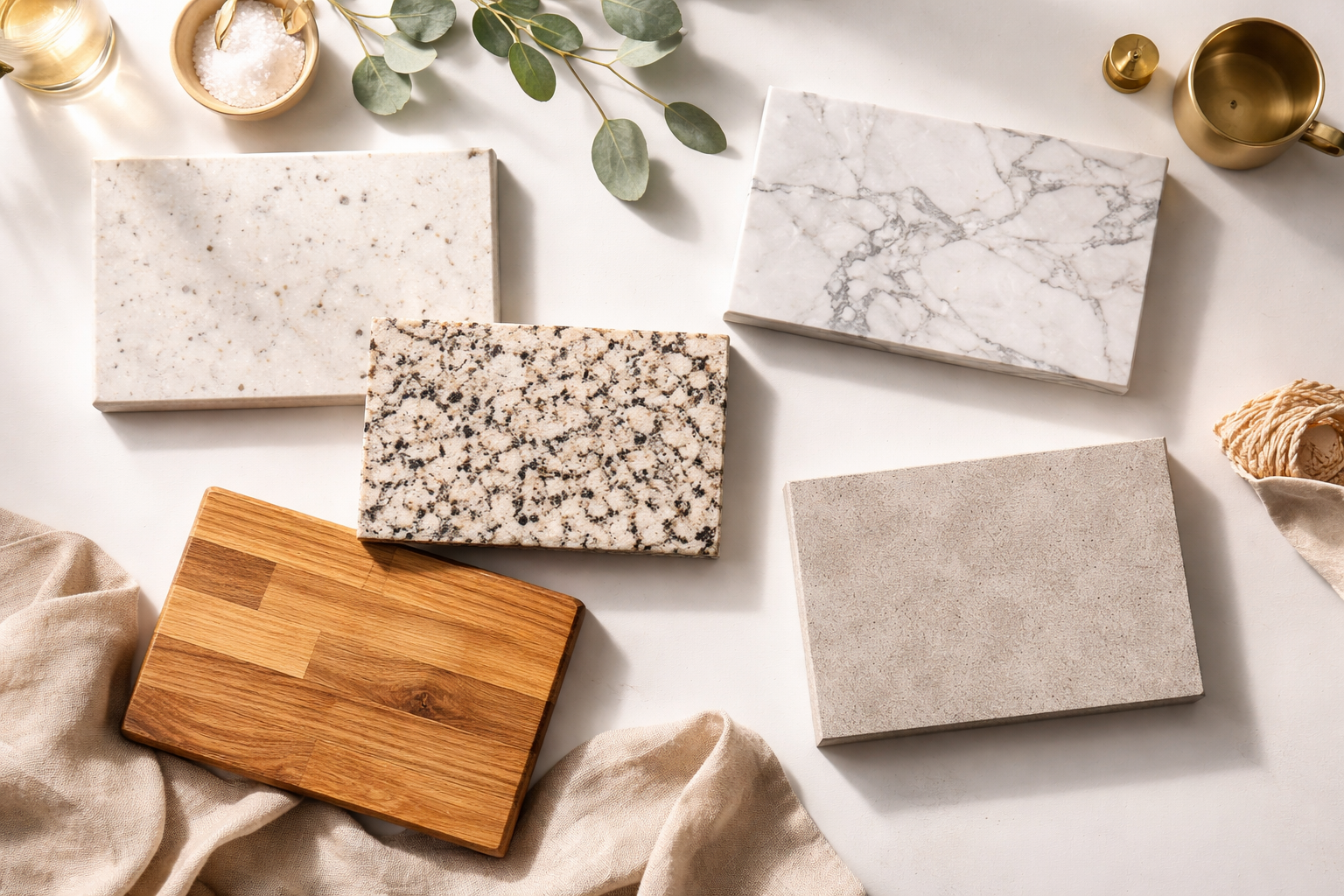
| Butcher block | $40–$75 | $1,600–$3,000 | Farmhouse style, island tops |
| Granite | $50–$100 | $2,000–$4,000 | Natural stone look, heat resistance |
| Quartz | $55–$120 | $2,200–$4,800 | Best all-around (most popular) |
| Quartzite | $80–$150 | $3,200–$6,000 | Premium natural stone, extreme durability |
| Marble | $75–$150 | $3,000–$6,000 | Luxury aesthetic (high maintenance) |
These are installed costs in the western suburbs market as of 2026 — including fabrication, templating, delivery, and installation. They assume a typical kitchen with 35–45 square feet of counter space, one sink cutout, and standard edge profiles.
Quartz — The Western Suburbs Favorite
Quartz dominates the western suburbs kitchen market right now, and for good reason. It’s an engineered stone (93% ground quartz bound with resin) that delivers the look of natural stone without the maintenance headaches.
Why it works here: Quartz requires zero sealing — ever. It’s non-porous, so coffee, wine, and tomato sauce wipe right off. It’s consistent in color and pattern across the whole slab, which matters when you’re matching a long L-shaped counter with an island. And it’s available in hundreds of colors and patterns, including remarkably convincing marble and concrete looks.
Best brands I specify: Cambria (made in the US, premium price but exceptional quality), Silestone (good mid-range, widest color selection), and Caesarstone (excellent balance of quality and price). The cost difference between these brands is typically $10–$25 per square foot installed — meaningful but not dramatic on a 40 sq ft kitchen.
The one drawback: Quartz doesn’t handle direct heat well. A hot pan from the stove can discolor or crack the resin. Always use trivets. This is the single most common quartz damage I see in western suburbs kitchens.
My recommendation: For most kitchens in the $28,000–$55,000 range — which is the sweet spot for Schaumburg, Arlington Heights, and Hoffman Estates mid-range remodels — quartz is the right choice. You get the visual impact of premium stone with lower maintenance and a predictable budget.
Granite — Still Relevant, But Know the Trade-Offs
Granite was the undisputed kitchen counter king from 2000–2015. It’s lost market share to quartz, but it’s still a solid choice — especially if you value natural stone character and heat resistance.
What granite does well: Each slab is unique — a natural stone with depth and variation that engineered materials can mimic but not quite replicate. It handles heat directly (you can set a hot pot on granite without damage). And granite prices have actually decreased over the past decade as quartz has taken market share, making mid-grade granite surprisingly affordable.
The maintenance reality: Granite needs sealing once a year — a 15-minute job with a spray-on sealer, but it’s one more thing on the list. Lighter-colored granites (whites, creams) are more porous and stain-prone than darker varieties. And because every slab is natural, what you see in the showroom might not exactly match what gets installed — always visit the stone yard and pick your specific slab.
Best fit: Homeowners who want genuine natural stone character, frequently cook with hot pans, and don’t mind the annual sealing routine. Also excellent for outdoor kitchens (which are growing in popularity across the western suburbs) since granite handles weather and UV better than quartz.
Quartzite — The Premium Natural Option
Quartzite is not quartz — despite the confusingly similar name. It’s a natural stone (metamorphosed sandstone) that’s harder than granite and has a luminous, marble-like appearance without marble’s staining issues.
Why it’s gaining popularity: Quartzite gives you the organic beauty of marble — veining, movement, depth — with dramatically better durability. It’s heat resistant, scratch resistant, and holds up well in high-use kitchens. Brands like Taj Mahal and Calacatta quartzite are stunning in person.
The reality check: Quartzite is expensive — $80–$150 per square foot installed. It still requires sealing (though less frequently than granite — every 1–2 years). And fabrication is more expensive because the stone is harder to cut and requires specialized tools. Total installed cost for a typical kitchen runs $3,200–$6,000.
Best fit: High-end kitchens in Naperville, Wheaton, Glen Ellyn, and other higher-value western suburbs homes where the budget supports premium materials and the homeowner wants a true natural stone statement piece.
Laminate — Better Than You Think
I know — laminate has a reputation problem. But modern laminate from Formica and Wilsonart is a completely different product from the Formica your parents had in 1985. Today’s laminate comes in realistic stone, wood, and concrete patterns, with squared or waterfall edges that look surprisingly upscale.
At $25–$50 per square foot installed, laminate is the clear choice for cosmetic refreshes in the $12,000–$22,000 range, rental property kitchens, or situations where you want to allocate more budget to cabinets and appliances. I’ve used premium laminate in Schaumburg and Elk Grove Village kitchens where homeowners spent $7,000 on great cabinets and $1,500 on laminate counters — and the kitchens look fantastic.
Design Tips From 15 Years of Kitchen Work
Don’t match — coordinate. Your countertop doesn’t need to match your backsplash or your flooring. It needs to coordinate. A white quartz counter, a warm-toned subway tile backsplash, and medium wood-tone flooring create visual interest. Matching everything to the same color creates a flat, monotone kitchen.
Consider the edge profile. The edge profile is a small detail that reads as quality (or lack thereof). Eased and beveled edges are standard and clean. Ogee and bullnose are more traditional. Waterfall edges (where the counter material continues down the sides of an island) are the current high-end trend — beautiful, but add $1,000–$2,500 to the island cost.
Think about the seam plan. On L-shaped or U-shaped counters, you’ll have at least one seam. A good fabricator places seams at natural transition points and matches the pattern across the seam so it’s nearly invisible. Ask to see the seam plan before fabrication begins.
Related guides: Kitchen Remodel Cost in Schaumburg · Kitchen Remodeling Services
Ready to choose your countertop? PHI3 Construction works with trusted fabricators across the western suburbs and can help you select the right material for your kitchen and budget. Request a free estimate.
About Sarah Chen — Sarah is a design consultant with 15 years of experience helping western suburbs homeowners plan kitchen and bathroom renovations. She balances aesthetics with budget reality, focusing on design choices that work in real suburban homes.