How a New Concrete Driveway Affects Home Value in Arlington Heights
A new concrete driveway sits in an awkward spot on most homeowners’ improvement lists. It costs real money. It does not change the daily experience of living in the home the way a kitchen or bathroom does. And the return-on-investment data, when you can find it, almost never makes the driveway look like a winner.
So what does it actually do for home value in Arlington Heights?
The short answer: a new driveway rarely raises a sale price by its full installed cost. What it does, reliably, is remove a problem from the buyer’s mental list. In a market where competing listings have cracked, settled, oil-stained driveways, a clean concrete slab is one less thing for a buyer to negotiate against. That has a different kind of value than a raw ROI percentage captures.
What the ROI Data Actually Says
The most-cited source on remodeling ROI is Remodeling magazine’s annual Cost vs. Value report. Driveway replacement is not its own category, but adjacent hardscape work consistently shows recovery in the 50 to 70 percent range at resale.
The National Association of Realtors’ Remodeling Impact Report is more useful here because it tracks both financial return and what it calls "joy score." Outdoor projects tend to score high on joy and lower on direct dollar recovery. A new driveway falls in that pattern. Homeowners report being satisfied with the result. Appraisers are mostly indifferent to it unless the old driveway was a visible defect.
The practical takeaway: do not replace a driveway purely for resale math. Replace it because the existing one is failing, because the home is being sold and the driveway is the first thing buyers see, or because the project is part of a broader curb-appeal plan that includes landscape, paint, and front-entry work.
Arlington Heights Pricing in 2026
Concrete driveway pricing in Arlington Heights tracks closely with the broader northwest suburbs. As of spring 2026, typical installed costs for full tear-out and replacement look like:
- Two-car driveway, roughly 500 to 600 square feet: $5,500 to $8,500
- Larger two-car with apron extension, 700 to 800 square feet: $7,500 to $11,500
- Three-car or extended driveway, 900 to 1,200 square feet: $10,000 to $16,500
- Decorative options (stamped, exposed aggregate, integral color): add $4 to $9 per square foot over standard
Those ranges assume four-inch slabs over compacted base on a residential driveway. Reinforced five-inch slabs with proper rebar or wire mesh, recommended for driveways that see heavier vehicles or sit on questionable subgrade, will push the high end of each range up by roughly $1.50 to $2.50 per square foot.
Removal of the existing driveway is usually included in quotes, but worth verifying. Older Arlington Heights homes sometimes have a layer of asphalt over original concrete, which adds disposal cost.
What Buyers in Arlington Heights Actually Notice
Listing agents working the Arlington Heights market tend to point at a few patterns when driveways come up in showings:
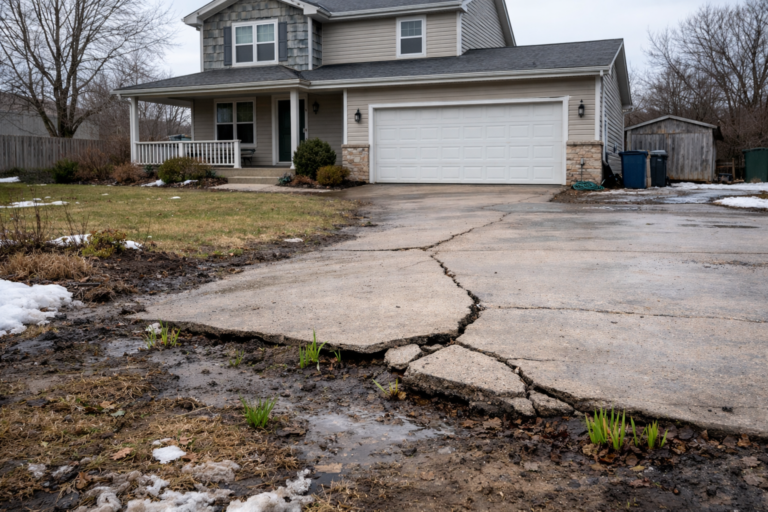
Cracks and settlement. A driveway with hairline cracks looks lived-in. A driveway with structural cracks, lifted edges, or settled panels reads as deferred maintenance. Buyers translate that into a discount request, often more than the actual repair would cost.
Slope and drainage. Buyers walking up a driveway notice if water has pooled at the garage door or run toward the foundation. Even if the surface looks fine, drainage problems flag potential foundation concerns.
Width and parking math. Households with two SUVs and a teenager need room for three vehicles. A narrow driveway that can only fit two in single file can quietly disqualify a home from a buyer’s short list.
Curb appeal as a system. A new driveway against an aging walkway and stained garage apron does not photograph well. Buyers and online listing scrolls reward visual consistency.
Quality Factors That Protect the Investment
The difference between a driveway that holds value and one that becomes a problem in five years usually comes down to four things, none of which show up in the final visible product:
Base preparation. Arlington Heights sits on the heavy clay soils common across Cook County. Clay heaves with freeze-thaw cycles. A driveway poured on poorly compacted base, or without enough compacted aggregate, will crack regardless of mix quality. Four inches of compacted CA-6 base is a reasonable minimum. Six inches is better on driveways carrying heavier vehicles.
Mix design. Standard residential driveways in this region should use a 4,000 psi mix with air entrainment. Air entrainment creates microscopic voids in the cured concrete that give freezing water somewhere to expand. Skipping air entrainment to save a few dollars per yard is the single most common cause of premature surface failure in Chicago-area driveways.
Control joints. Concrete is going to crack. The question is whether it cracks where the contractor planned or somewhere unsightly. Control joints, typically cut at one-fourth the slab depth and spaced at intervals roughly two to three times the slab thickness in feet, give the slab a designed weak point. A driveway without enough control joints, or with joints cut too shallow, will crack randomly within the first two winters.
Curing. Concrete needs to cure slowly with moisture retained at the surface. In summer pours, that often means a curing compound applied right after finishing, or wet burlap and plastic for several days. Crews that pour and walk away on a hot July afternoon are setting up surface scaling that will appear two winters later.
A homeowner reviewing quotes does not need to be a concrete expert. They need to ask the contractor what mix is being specified, how thick the base is, how joints are being placed, and what the curing plan is. A contractor who answers those four questions clearly is operating at a different level than one who waves them off.
Local Conditions That Matter
Three Arlington Heights realities shape what a driveway has to survive:
Freeze-thaw cycles. A typical winter brings 40 to 60 freeze-thaw cycles. Each one is a stress event on the concrete surface, especially where deicing salt has been applied.
Deicing salt. Sodium chloride is the standard, and it is hard on concrete. The damage compounds over years. Calcium magnesium acetate is gentler but more expensive. Either way, any new driveway should be allowed to cure for at least 30 days before any salt application, and ideally should be sealed in its first fall.
Clay subgrade. Arlington Heights soils move with moisture. Driveways on poorly drained subgrades crack early and unpredictably. Drainage improvements, like a properly graded base and edge drainage where the driveway meets landscaping, extend useful life significantly.
Permits in Arlington Heights
The Village of Arlington Heights generally requires a permit for full driveway replacement, especially when work touches the apron, expands the driveway footprint, or changes drainage patterns. Like-for-like replacement of an existing driveway sometimes proceeds without a permit, but contractors often pull one anyway because village inspectors notice fresh concrete work and asking forgiveness later is a poor strategy. Verify current requirements through the Village of Arlington Heights Community Development department.
Timing the Replacement
The decision tree for most Arlington Heights homeowners looks like this:
- Planning to sell within 12 to 18 months and the driveway is visibly deteriorated: replace it. The driveway will not pay for itself in sale price, but it removes a negotiation point and improves first impressions in listing photos.
- Planning to stay another five-plus years and the driveway is functional but aging: wait. A new driveway five years before selling captures most of its useful life for the current owner and reads as worn by listing time.
- Driveway has structural failure now: replace regardless of selling plans. Lifted panels and trip hazards are liability issues, and continued deterioration only raises eventual replacement cost.
Frequently Asked Questions
How long should a new concrete driveway last in Arlington Heights?
A properly installed concrete driveway with adequate base, correct mix design, and reasonable maintenance should last 25 to 35 years in this climate. Driveways with shortcuts in any of those areas commonly fail in 10 to 15 years.
Does sealing a new driveway actually matter?
Yes, especially in the first few years. A penetrating siloxane or silane sealer applied in the first fall after pour, and reapplied every two to three years, reduces salt and water penetration substantially. It is not optional maintenance for a driveway expected to last decades.
Will a stamped concrete driveway add more value than plain?
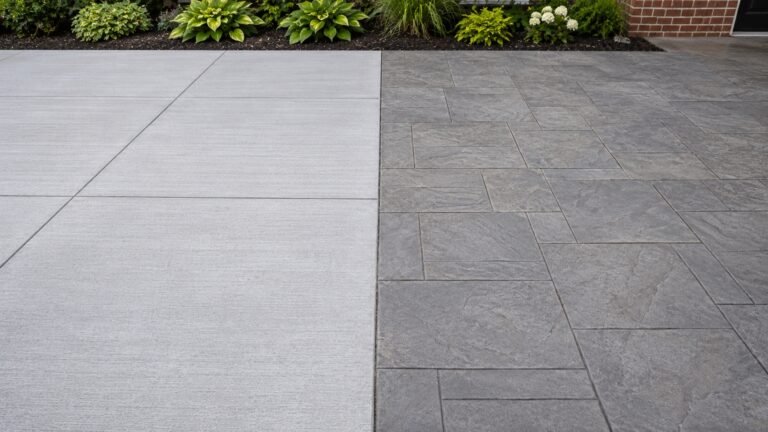
Sometimes. Stamped concrete improves visual appeal and can lift listing photos, but adds $4 to $9 per square foot to the project. In Arlington Heights’ established neighborhoods where most driveways are plain broom-finished concrete, a stamped driveway may stand out positively or read as out of character depending on the architectural style. A direct comparison of stamped versus plain concrete value helps homeowners weigh the trade-off.
What is the right time of year to pour a driveway in Arlington Heights?
Late April through mid-November is the safe window. Pours below 40 degrees ambient require special precautions and are usually not worth the risk on residential work. The best windows for surface quality tend to be mid-May through June and mid-September through October, when temperatures are moderate and curing conditions are forgiving.
How do Arlington Heights driveway costs compare to nearby towns?
Pricing is similar across the northwest and west suburbs. Addison, Hoffman Estates, Schaumburg, and Palatine all run within roughly 10 percent of each other for comparable work. Cost comparisons between concrete and asphalt in Hoffman Estates and driveway replacement costs in Addison provide useful local context.
The Bottom Line on Driveways and Home Value
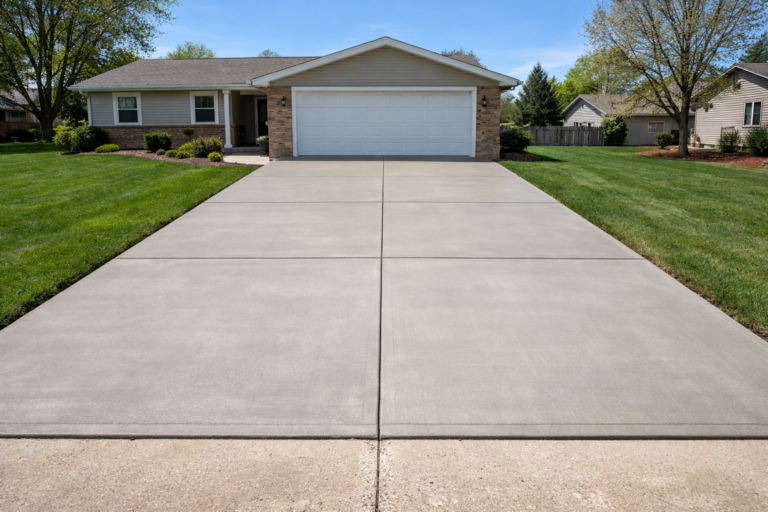
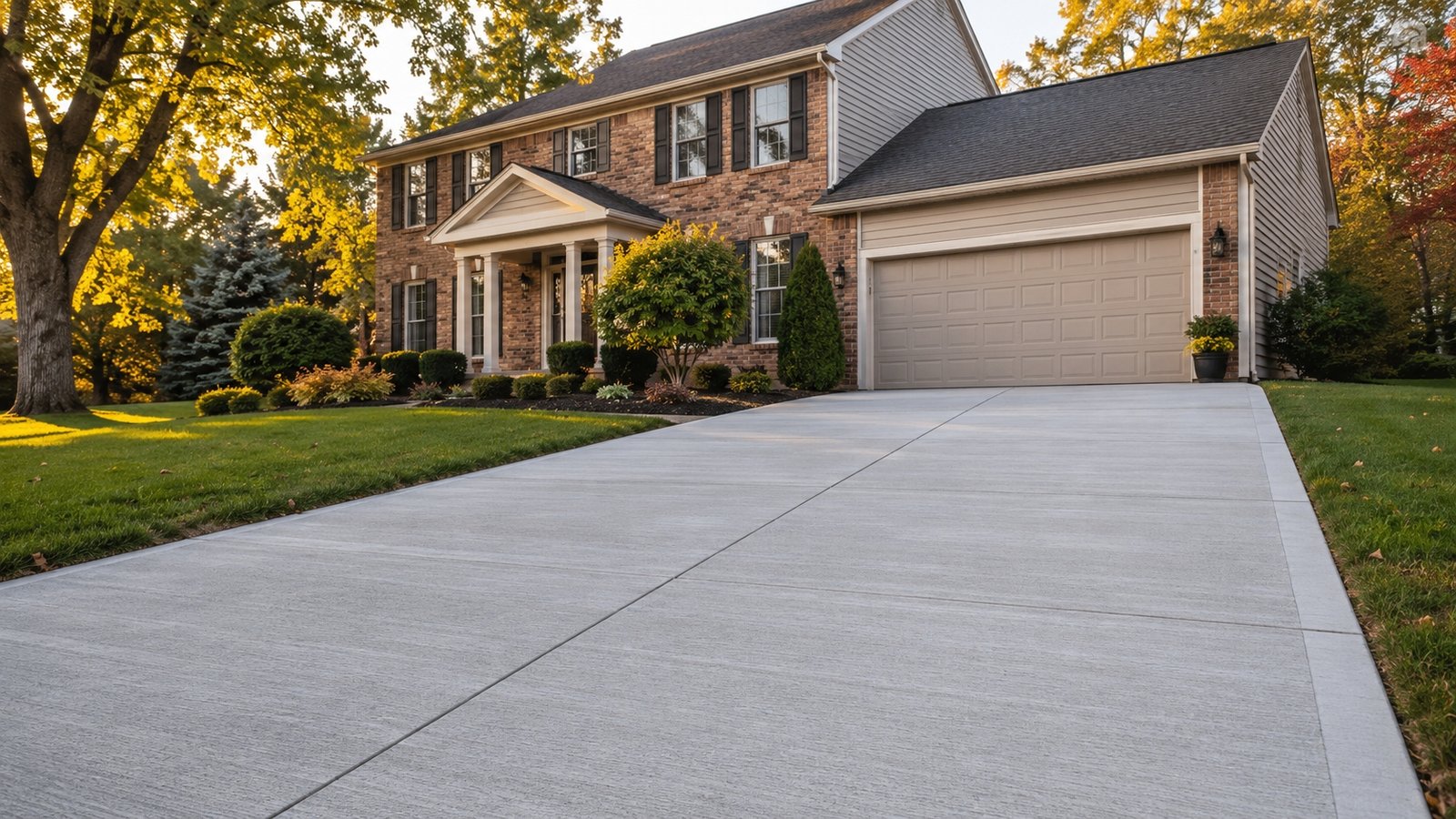
A new concrete driveway is rarely the strongest dollar-for-dollar resale investment. It is, however, one of the most visible elements of a home’s exterior and the first thing buyers see. When the existing driveway is failing, replacement protects the rest of the home’s curb appeal and removes a buyer-negotiation point. When it is functional, the money is usually better spent elsewhere.
Homeowners weighing replacement against repair, or trying to decide between standard and decorative finishes, benefit from getting quotes from contractors who will explain the base prep, mix, and joint plan before quoting a price. Readers can use the publication’s free estimate request form to connect with a vetted local contractor. For broader context on concrete work in the area, the Concrete and Driveways services overview covers the full range of options.