Garage Floor Coatings: Epoxy vs. Polyaspartic for Chicago-Area Garages
Your garage floor takes more abuse than any other concrete surface on your property. Road salt tracked in by every car, oil drips, hot tire pickup in summer, and moisture from snowmelt — all in a space that’s probably unheated and subject to the same freeze-thaw cycling as your driveway. If your garage floor is spalling, staining, or just looks terrible, a coating is the most cost-effective upgrade you can make. But the coating you choose matters enormously in this climate.
I’ve been coating garage floors across Addison, Schaumburg, Elk Grove Village, and the western suburbs for 25 years. Here’s the honest comparison between the two real options: epoxy and polyaspartic.
Cost Comparison
| Coating Type | 2-car garage (400-500 sq ft) | Cost per sq ft |
|---|---|---|
| DIY epoxy kit (big box store) | $200–$500 | $0.50–$1.00 |
| Professional epoxy (multi-coat) | $1,500–$4,000 | $3–$8 |
| Professional polyaspartic | $2,500–$5,500 | $5–$11 |
| Full flake system (epoxy base + polyaspartic top) | $3,000–$6,000 | $6–$12 |
Before you grab a $200 epoxy kit from Home Depot — I’ve scraped more failed DIY garage coatings off floors than I can count. Those kits are thin, single-coat products that peel within 1–2 winters in an unheated Chicago garage. Professional coatings are 4–10× thicker, properly bonded to prepared concrete, and formulated for temperature extremes. The cost difference pays for itself in not having to redo the job in two years.
Epoxy: The Established Choice
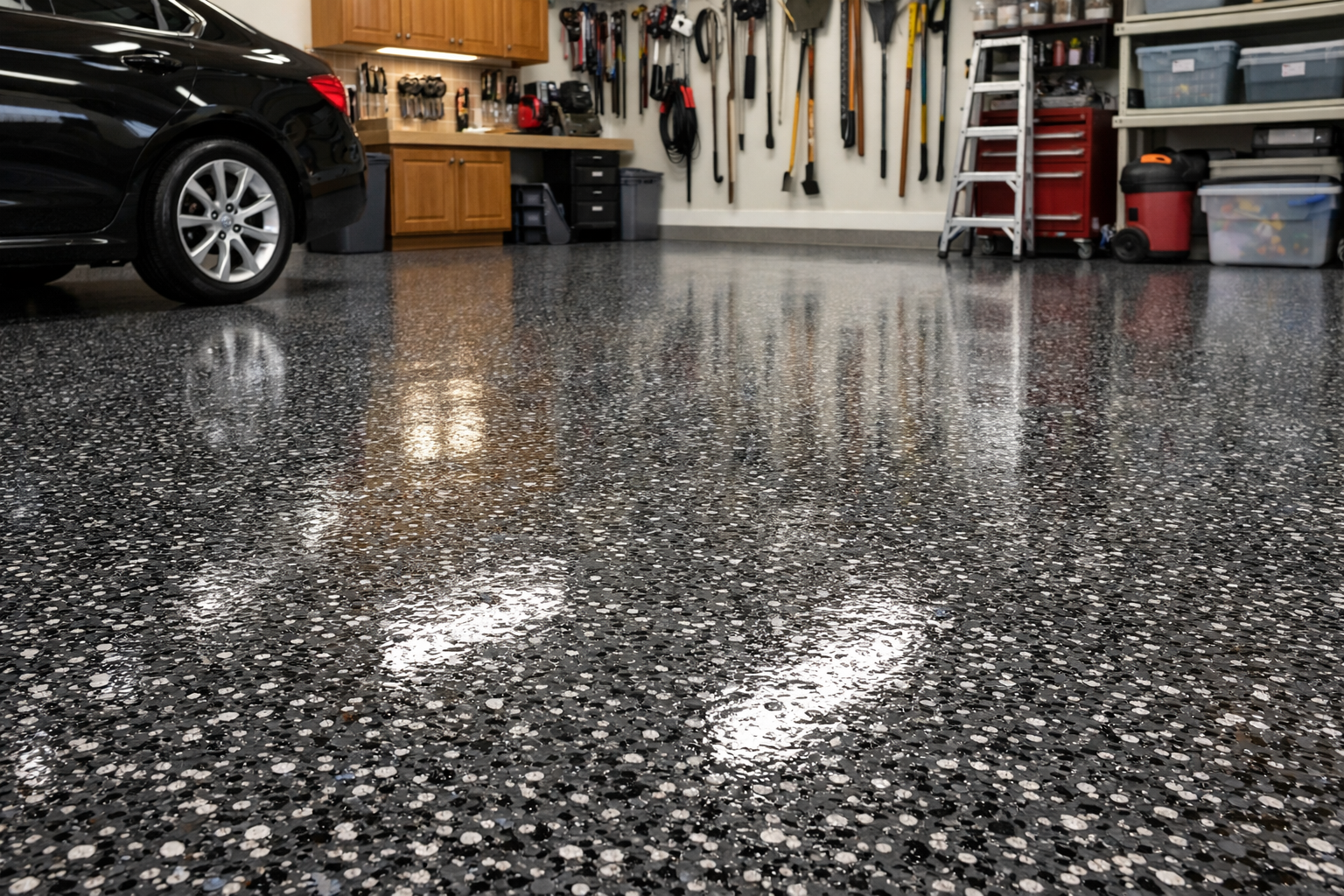
Professional epoxy coatings have been the standard for garage floors for decades. A proper epoxy system includes diamond grinding or shot blasting the concrete surface for mechanical adhesion, a primer coat that penetrates the concrete pores, one or two coats of 100% solids epoxy (not the water-based stuff in retail kits), decorative flake broadcast (optional but popular), and a clear topcoat for UV and abrasion resistance.
Pros: Excellent chemical resistance (oil, gas, brake fluid), extremely durable surface (10–15+ years with proper prep), wide range of color and flake options, proven track record, and lower cost than polyaspartic.
Cons for Chicago garages: Epoxy is temperature-sensitive during application — it needs 50°F+ ambient temperature and concrete temperature for proper curing. In an unheated garage, this limits your installation window to roughly May through October. Cure time is also long: 24 hours before foot traffic, 72 hours before vehicles. And here’s the big one for the western suburbs — standard epoxy can yellow with UV exposure near the garage door opening, and it becomes slippery when wet unless you add anti-slip aggregate to the topcoat.
Polyaspartic: The Premium Option
Polyaspartic coatings are a newer technology that’s become the premium choice for garage floors in cold climates. The application process is similar to epoxy — grind, prime, coat, flake, topcoat — but the chemistry is different in ways that matter for Chicago garages.
Pros for Chicago garages: Polyaspartic cures in 4–6 hours, meaning the entire job — including a full flake system — can be done in one day. Your car can be back in the garage the next morning. It cures at temperatures as low as 20°F, so installation is possible year-round in an unheated garage. It doesn’t yellow from UV exposure. And it has better flexibility than epoxy, which means it handles thermal expansion and contraction better through our temperature swings.
Cons: Higher cost (30–50% more than epoxy). Shorter working time during application — the fast cure that’s an advantage for the homeowner is a challenge for the installer, requiring experienced crews who can work quickly and evenly. And polyaspartic has a stronger odor during application (proper ventilation is essential).
My Recommendation for Western Suburbs Garages
For unheated garages in Schaumburg, Addison, and the surrounding suburbs — which is 90% of the garages I work on — polyaspartic is the better choice. The temperature flexibility alone is worth the premium. Being able to install in November or March (when most homeowners actually think about their garage floor, as they’re looking at it every day through winter) instead of waiting for a May warm spell is a practical advantage.
The one-day cure is also huge. With epoxy, you’re parking on the street for 3–5 days. With polyaspartic, you’re back to normal the next day. For families with two cars and no extra covered parking, that matters.
If budget is the primary concern and you can schedule the work in summer, professional epoxy with a polyaspartic topcoat (the hybrid system at $3,000–$6,000) gives you epoxy’s cost advantage on the base coats with polyaspartic’s UV resistance and fast cure on the topcoat. Best of both worlds.
When Your Floor Needs Replacement, Not Coating
Coatings work on structurally sound concrete with surface-level issues — staining, minor scaling, cosmetic wear. They don’t fix structural problems. If your garage floor has sections that have heaved or settled more than 1/2 inch, widespread deep cracking (not just hairline surface cracks), significant spalling where chunks of concrete are breaking loose, or moisture coming up through the slab (do the plastic sheet test — tape a 2×2 piece of plastic to the floor for 24 hours; if moisture collects underneath, you have a vapor issue), then you need a floor replacement ($3,500–$7,000 for a standard 2-car garage) before any coating will work.
Prep Work Is Everything
The single biggest factor in whether a garage floor coating lasts 2 years or 15 years is surface preparation. The concrete must be profiled — meaning the smooth surface is roughened so the coating has something to grip. Diamond grinding is the gold standard: it removes the top layer of concrete, opens the pores, and creates a consistent profile across the entire floor.
If a contractor tells you they’ll “acid etch” your floor instead of grinding it, that’s a red flag. Acid etching is inconsistent, doesn’t remove previous sealers or contaminants, and creates a weaker bond. Every coating failure I’ve been called to fix started with inadequate surface prep.
Cracks need to be repaired with flexible polyurea filler before coating. Oil stains need to be cut out or treated with a degreaser and ground down. Any previous coating needs to be fully removed. This prep work takes 3–5 hours for a typical 2-car garage and represents a significant portion of the labor cost — but it’s what makes the difference between a coating that lasts and one that peels.
Related guides: Driveway Replacement Costs in Addison · Concrete & Driveway Services
Thinking about coating your garage floor? PHI3 Construction installs both epoxy and polyaspartic systems across the western suburbs. We’ll assess your floor’s condition and recommend the right system for your garage. Request a free estimate.
About Stan Kowalski — Stan is a concrete and flatwork specialist with 25 years of experience across Chicago’s western suburbs. He grew up on Chicago’s northwest side and started pouring concrete as a teenager. His articles focus on the technical details that determine whether your concrete lasts 10 years or 30.