When to Repair vs. Replace a Concrete Driveway in Palatine
Every concrete driveway in Palatine takes the same punishment. Winter freeze-thaw cycles, road salt tracked in from Rand Road and Northwest Highway, and the heavy clay soils that shift with every wet spring. After 15 or 20 years, the surface tells the story: hairline cracks, spalling corners, maybe a slab that has settled an inch lower than its neighbor.
The question most homeowners face at that point is not whether to do something. It is whether a targeted repair will buy another decade of life or whether the driveway has crossed the line where only a full replacement makes financial sense.
The answer depends on what is actually wrong, not just what looks wrong from the street.
Cracks That Can Be Repaired (and Stay Repaired)
Not all cracks mean the driveway is failing. Hairline surface cracks under a quarter inch wide are cosmetic. They develop as concrete cures and contracts, and they rarely get worse if the base underneath is stable. A quality polyurethane or epoxy crack filler handles these for under $200 in materials, or $300 to $600 if a contractor does the work.
Slightly wider cracks, up to about half an inch, can also be filled and sealed effectively. The key factor is whether the crack is static or active. A static crack appeared once and stopped moving. An active crack gets wider with seasonal temperature swings. Static cracks are straightforward repairs. Active cracks need flexible sealant and sometimes routing (widening the crack channel so the sealant has room to flex), but they can still be managed without replacement.
Control joints that have opened up wider than originally cut are another common repair. These joints were placed during the pour specifically to control where cracking happens. If they are doing their job and the slabs on either side are level, re-sealing the joints is routine maintenance, not a sign of failure.
Cost range for crack repairs in Palatine (2026): $150 to $800 for a typical two-car driveway, depending on the number of cracks and whether the homeowner does the work or hires out.
Surface Damage: Spalling, Scaling, and Discoloration
Spalling is the flaking or chipping of the top layer of concrete. In the Chicago suburbs, it is almost always caused by deicing salt, poor finishing during the original pour, or a combination of both. Light spalling on an otherwise sound slab can be addressed with a concrete resurfacing overlay, which bonds a new thin layer (typically three-eighths to half an inch) over the existing surface.
Resurfacing works well when the base is solid and the damage is limited to the top quarter inch or so. It costs significantly less than replacement: expect $3 to $6 per square foot in the Palatine area, which puts a 600-square-foot driveway at roughly $1,800 to $3,600 installed.
However, resurfacing has limits. If the spalling goes deeper than half an inch, if multiple slabs show damage, or if the concrete sounds hollow when you tap it (indicating delamination below the surface), an overlay will not bond properly. It will peel within a year or two, wasting the investment.
Scaling, where the surface peels in thin sheets, follows the same logic. Shallow and localized means resurfacing is viable. Deep and widespread means replacement.
When the Base Has Failed
The concrete surface is only as good as the base underneath it. In Palatine and across Cook County’s northwest suburbs, the native soil is heavy clay that expands when wet and shrinks when dry. A properly installed driveway sits on four to six inches of compacted gravel base that distributes loads and drains water away from the slab. When that base erodes, settles unevenly, or was never installed correctly in the first place, the concrete above it cracks and shifts.
Signs of base failure include:
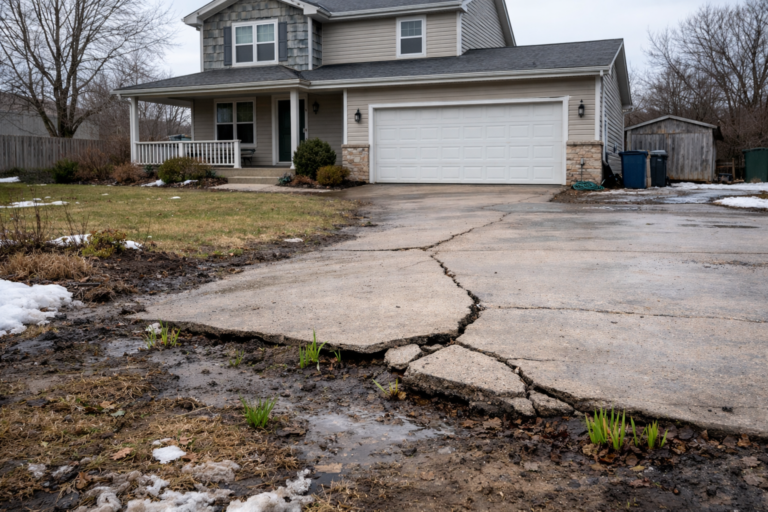
Slabs that have settled noticeably lower than adjacent slabs, creating a step or lip at the joint. A quarter inch of difference is cosmetic. Half an inch or more, especially if it is getting worse year over year, points to ongoing settlement.
Rocking or movement when you drive over a section. If a slab moves under the weight of a car, the base underneath has a void.
Large cracks that run the full width of the driveway, especially if the two sides of the crack are at different heights. This is not a surface issue. The ground moved.
Mudjacking (pumping a slurry under the slab to lift it) or polyurethane foam injection can sometimes correct minor settlement for $500 to $1,500 per slab. But these are stabilization measures, not permanent fixes. If the underlying soil continues to move, the slab will settle again. For a driveway with multiple settled slabs and active soil movement, replacement with proper base preparation is the better long-term investment.
The Full Replacement Decision
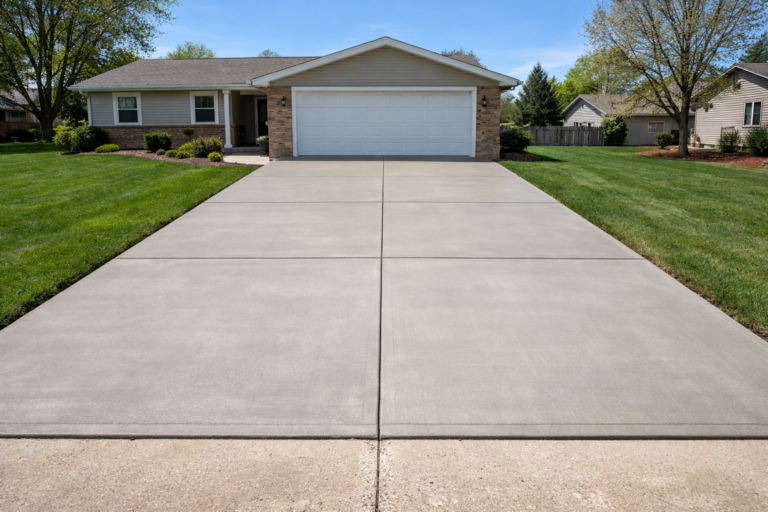
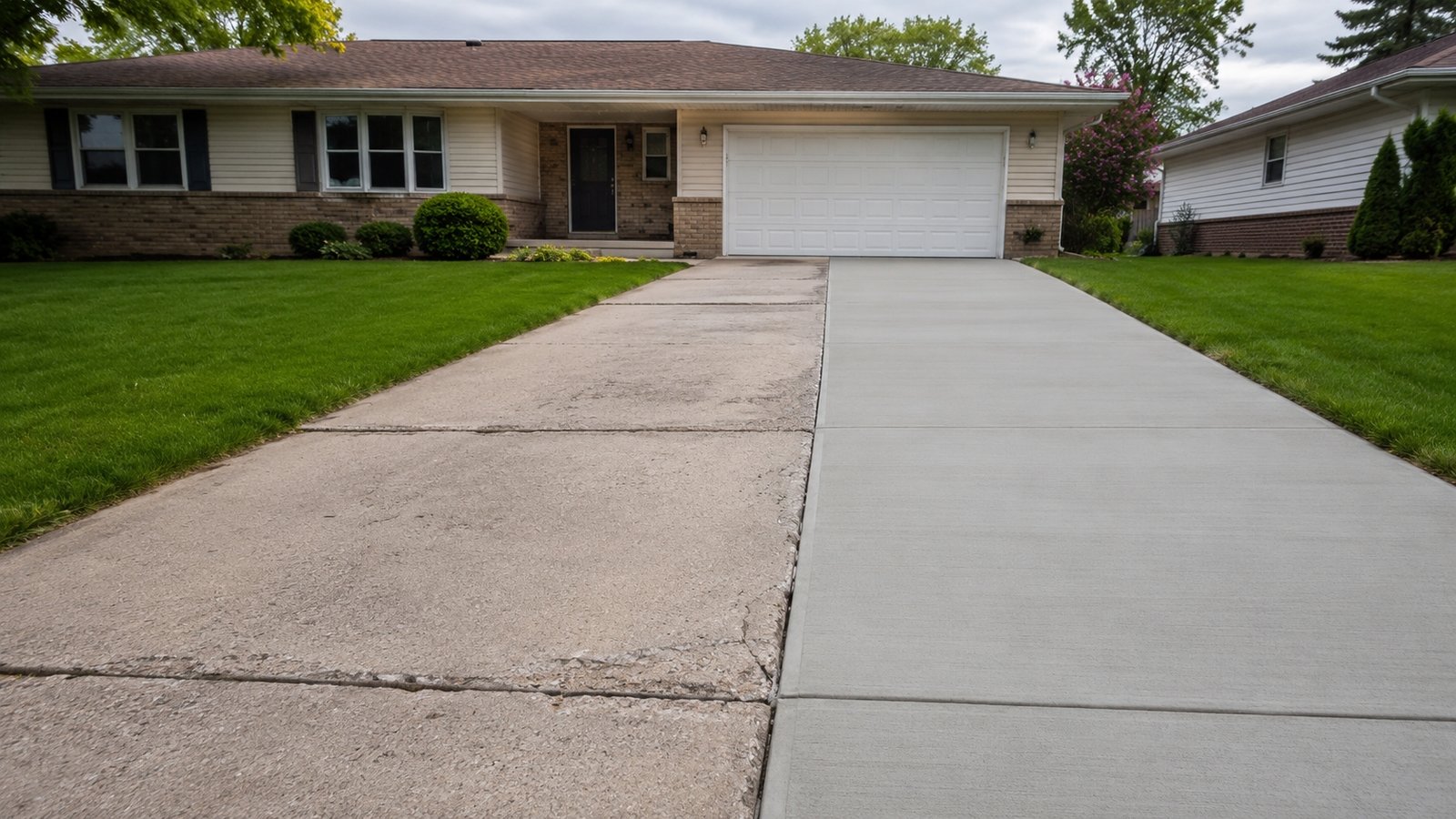
Replacement means tearing out the existing concrete, re-grading and compacting the base, and pouring new slabs. It is disruptive (expect three to five days without driveway access, plus a seven-day cure before driving on it) and it is the most expensive option. But when a driveway has multiple overlapping problems, replacement is often cheaper over a ten-year window than a cycle of repairs that never fully solve the issue.
Conditions that point toward replacement:
The driveway is more than 25 years old and showing problems across the majority of its surface, not just in one or two spots.
More than 30 to 40 percent of the total area has cracks wider than half an inch, spalling, or settlement.
Previous repairs have already been done and the problems returned within two to three years.
The driveway grade (slope) directs water toward the garage or foundation. A replacement lets the contractor correct the grade, which a repair cannot do.
You are planning to sell within the next few years and the current condition is visibly poor from the street. A patched driveway reads as deferred maintenance to buyers. A new pour reads as a home that has been cared for. (For more on how a new driveway affects resale, see How a New Concrete Driveway Affects Home Value in Arlington Heights.)
What Replacement Costs in Palatine (2026)
A standard concrete driveway replacement in Palatine runs $6 to $12 per square foot installed, depending on thickness (four inches is standard, six inches for heavier loads), base work required, and finish. For a typical two-car driveway of 500 to 700 square feet, that translates to roughly $3,000 to $8,400.
Factors that push toward the higher end: a longer or wider driveway, significant base excavation and re-compaction, removal of an existing driveway with rebar (versus wire mesh), a broom finish upgrade to exposed aggregate or stamped borders, and ADA-compliant sidewalk connections if the village requires them.
The Village of Palatine does not require a permit for a like-for-like driveway replacement on a single-family residential lot, but it does require a permit if the driveway footprint changes (wider, longer, or a new apron connecting to the public right-of-way). Check with the Palatine Building and Development Department before signing a contract if your project involves any changes to the driveway’s size or location.
For comparison, here is what neighboring towns are seeing: driveway replacement costs in Addison run in a similar range, while Hoffman Estates homeowners weighing concrete against asphalt face a different set of trade-offs.
A Simple Decision Framework
Before calling a contractor, walk your driveway and answer three questions honestly:
1. Is the damage cosmetic or structural? Hairline cracks, minor spalling, and control joint gaps are cosmetic. Settled slabs, full-width cracks, and hollow-sounding concrete are structural.
2. How much of the driveway is affected? If the problems are limited to one or two slabs out of six or eight, targeted repair or mudjacking is reasonable. If more than a third of the surface is compromised, the math shifts toward replacement.
3. How old is the driveway, and has it been repaired before? A 12-year-old driveway with one bad slab is a repair candidate. A 25-year-old driveway that was patched five years ago and is cracking again is telling you the base has reached the end of its useful life.
If you land on replacement, or if you are not sure whether your situation calls for repair or a full pour, getting two or three quotes from local concrete contractors is the fastest way to pin down real numbers for your specific driveway. Request a free estimate to start that conversation.
Timing Matters in Northern Illinois
Concrete pours in the Chicago suburbs have a seasonal window. Most contractors pour from late April through mid-October, with May through September being the ideal range. Pouring in cold weather (below 50 degrees at the time of the pour and for the curing period) risks poor hydration and a weaker slab.
If your driveway needs work, the best time to get quotes is late winter or early spring, before contractor schedules fill up. The best time to pour is late spring through early fall, when overnight temperatures reliably stay above 50 degrees.
Planning ahead also matters for the concrete driveway process overall. From first quote to finished slab, expect three to six weeks of lead time during peak season.
The Bottom Line
Palatine homeowners do not need to tear out a driveway over a few hairline cracks. But they also should not keep patching a slab that has fundamental base problems. The dividing line comes down to what is happening underneath the surface, how much of the driveway is affected, and whether previous repairs have held.
A targeted repair on a sound driveway buys five to ten more years for a few hundred dollars. A replacement on a failing one costs more upfront but resets the clock to a 25-to-30-year lifespan and eliminates the cycle of diminishing returns from repeated patches.