
Patio Installation in Addison, IL: Materials, Costs, and What Your Contractor Won’t Tell You
Addison homeowners have been calling me about patios for over 30 years, and the conversation almost always starts the same way: “I got a quote and I have no idea if it’s fair.” That’s because patio pricing in the western suburbs is genuinely confusing — the range between a basic concrete slab and a full paver patio with a fire pit and seating walls is enormous, and most contractors aren’t great at explaining why.
This guide breaks down what patios actually cost in Addison, IL in 2026, which materials make sense for our climate and soil, and a few things your contractor probably won’t mention unless you ask. I’ve installed hundreds of patios across Addison, Roselle, Bloomingdale, and the surrounding area, and I’m going to give you the same advice I’d give a family member.
Why Addison’s Soil and Climate Make Patio Work Different
Before we talk numbers, you need to understand what’s happening underneath your patio — because in Addison, the ground is working against you. DuPage County sits on heavy clay soil that expands when it’s wet and contracts when it dries. Add in 50+ freeze-thaw cycles per winter (the Chicago area typically sees temperatures cross the 32°F threshold 80–100 times per season), and you’ve got a recipe for heaving, cracking, and settling that homeowners in drier, sandier climates simply don’t deal with.
This is why base preparation is the single most important factor in whether your patio lasts 5 years or 25 years. A properly prepared patio base in Addison requires excavating 8–12 inches of clay soil, installing 6–8 inches of compacted Class 3 limestone aggregate, and topping with 1 inch of bedding sand (for pavers) or using fiber-reinforced concrete with control joints at 8–10 foot intervals. Skip or shortcut the base, and you’re looking at cracked concrete or heaved pavers within three winters.
This is the first thing your contractor might not tell you: the base work represents 30–40% of the total project cost, and it’s where the quality contractors separate themselves from the guys who’ll pour concrete on 2 inches of gravel and be gone before the first frost.
Patio Material Options and Costs for Addison
Here are real 2026 costs for the most common patio materials, based on projects I’ve completed in Addison and the surrounding western suburbs. All prices include materials, labor, base preparation, and cleanup for a standard 300-square-foot patio (roughly 15×20 feet, which is the most common size I install in Addison’s typical lot sizes).
Poured Concrete: $3,500–$7,500
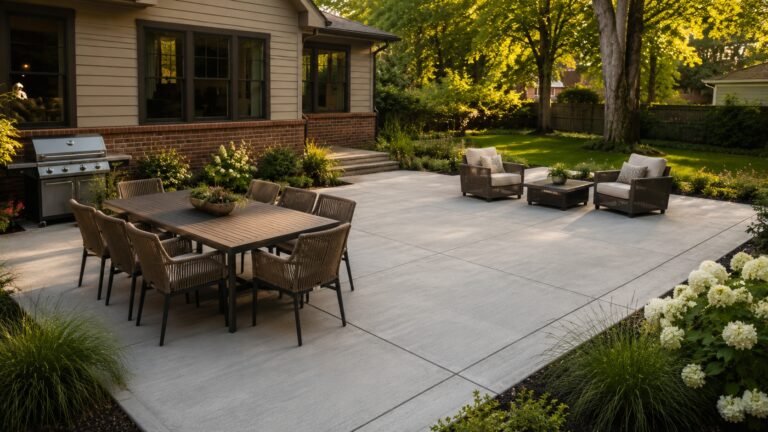
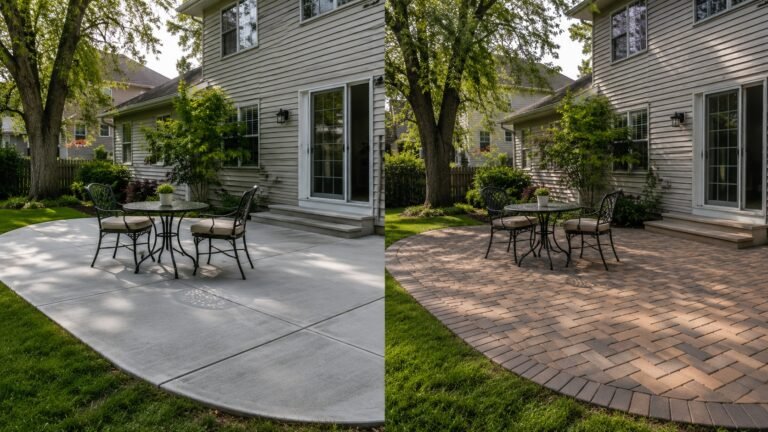
Poured concrete remains the most affordable option and performs well in our climate when installed correctly. A basic broom-finished concrete patio in Addison runs $12–$18 per square foot installed, including proper base preparation. Stamped concrete — which mimics the look of pavers, flagstone, or brick — pushes that to $18–$28 per square foot.
For Chicago winters, I always specify 4,000 PSI concrete with air entrainment (tiny air bubbles that give the concrete room to expand during freeze-thaw) and fiber mesh reinforcement. This adds maybe $1–$2 per square foot over basic concrete but dramatically reduces cracking. I also insist on control joints every 8–10 feet — if the concrete is going to crack (and in Illinois, it will eventually), you want it to crack where you’ve planned for it, not across the middle of your new patio.
The downside of concrete: once it cracks, repair options are limited. You can fill cracks, but you can’t make them invisible. Replacing a cracked section means sawcutting and pouring new concrete that will never quite match the original color.
Concrete Pavers: $6,000–$14,000
Pavers are the most popular choice I install in Addison, and for good reason. They handle freeze-thaw dramatically better than poured concrete because the individual units flex with ground movement instead of cracking. If a section heaves or settles, you pull up the affected pavers, re-level the base, and reset them — a $200–$500 repair instead of a $2,000 concrete replacement.
Installed cost for concrete pavers in Addison runs $20–$35 per square foot for standard pavers (Unilock, Belgard, Techo-Bloc are the brands I work with most) and $30–$48 per square foot for premium large-format or textured pavers. The installed price includes the excavation, aggregate base, bedding sand, pavers, edge restraints, and polymeric sand in the joints.
One thing worth noting: paver patios require polymeric sand between the joints to prevent weed growth and ant hills. This sand needs to be replenished every 3–5 years ($200–$400 for a typical patio). It’s minimal maintenance, but it’s not zero maintenance — and some contractors won’t mention this.
Natural Stone (Flagstone/Bluestone): $10,000–$18,000+
Natural stone is the premium option and looks phenomenal when done right. Irregular flagstone on a dry-laid base runs $30–$45 per square foot installed. Full-thickness bluestone on a concrete base (the most durable option for our climate) runs $40–$60+ per square foot. Natural stone patios are the most expensive upfront but have the longest lifespan — a well-installed bluestone patio can last 50+ years with minimal maintenance.
The second thing your contractor might not tell you: not all natural stone performs equally in Chicago winters. Some limestone and sandstone varieties are porous and will spall (flake apart) after repeated freeze-thaw exposure. Bluestone, dense granite, and certain quartzite varieties handle our climate well. If a contractor is proposing natural stone and can’t tell you the freeze-thaw rating of the specific stone they’re specifying, find a different contractor.
What Your Contractor Probably Won’t Mention
After 30 years in this business, I know what gets glossed over in patio sales pitches. Here’s what you should be asking about.
Drainage is not optional. Addison’s clay soil doesn’t drain well on its own. Every patio needs to slope away from your house at a minimum of 1/4 inch per foot. If your yard is flat or slopes toward the foundation, you may need a French drain or channel drain system installed alongside the patio. This can add $1,500–$4,000 to the project, but it’s non-negotiable — water pooling against your foundation will cause basement leaks and far more expensive problems than the drain would have cost.
Permit requirements in Addison. The Village of Addison generally requires a building permit for any patio that’s attached to the house (like a covered patio or one connected to a deck) or that includes electrical work (lighting, outlets for an outdoor kitchen). A standard detached patio on grade typically doesn’t require a permit, but you need to comply with setback requirements — Addison’s code requires structures to be at least 3 feet from the rear and side property lines. If you’re planning a larger patio or one with a pergola or roof structure, pull a permit. It protects you, and it’s a sign of a contractor who does things right.
The “lifetime warranty” on pavers is misleading. Yes, Unilock and Belgard offer lifetime warranties on their pavers — against manufacturing defects. They don’t cover heaving, settling, poor installation, or drainage issues. The warranty is only as good as the installation underneath. A premium paver installed on a 2-inch gravel base will fail faster than a budget paver on a properly compacted 8-inch aggregate base.
Spring is the worst time to install a patio. I know that’s counterintuitive, but hear me out. Everyone calls in April and May, which means contractors are booked solid, lead times stretch to 6–8 weeks, and prices tend to be at their peak. Late summer and early fall (August through mid-October) is actually the ideal installation window in the Chicago area — the ground is dry and stable, contractors have more availability, and you may get better pricing. The patio needs to cure or set before the first hard freeze, so aim to have your project completed by early November.
Get your underground utilities marked. Before anyone digs in your Addison yard, call JULIE (Joint Utility Locating Information for Excavators) at 811. It’s free, it’s required by Illinois law, and it prevents your contractor from hitting a gas line or cutting your Comcast cable. Any contractor who starts digging without a JULIE locate is cutting corners you don’t want cut.
How to Compare Patio Estimates in Addison
When you’re comparing estimates from different contractors, make sure you’re comparing the same scope. Here’s what should be itemized in every patio estimate:
Excavation depth and disposal of excavated soil. Base material type and thickness (Class 3 aggregate, compacted in lifts). Paver or concrete specification (brand, product line, thickness, PSI rating). Edge restraint material and installation. Joint material (polymeric sand type). Drainage plan (slope direction, any drain systems). Cleanup and haul-away. Warranty terms — on both materials and labor.
If an estimate says “paver patio — $8,000” with no line items, that’s not an estimate — it’s a guess. And it’s usually a guess that doesn’t include adequate base preparation, proper edge restraint, or polymeric sand.
Size and Feature Add-On Costs
Most Addison homes sit on 60–75 foot wide lots, which limits backyard patio sizes compared to the larger lots you’ll find in Naperville or Wheaton. Here’s how add-ons affect your budget:
A fire pit (built-in, gas or wood-burning) adds $2,500–$6,000. A seating wall or retaining wall adds $40–$80 per linear foot. Patio lighting (low-voltage LED) adds $1,500–$4,000 for a typical installation. An outdoor kitchen stub-out (gas line, electrical, water) adds $2,000–$5,000. Steps from an elevated back door to grade-level patio add $1,000–$3,000 depending on material and height.
My advice: start with the patio itself and get the base and surface right. Features like fire pits and seating walls can be added in a later phase without disrupting the original installation, as long as your contractor plans for them upfront (running conduit for future lighting, for example).
The Bottom Line for Addison Homeowners
A patio is one of the best outdoor investments you can make in Addison — it extends your usable living space for six to seven months of the year and typically recoups 50–70% of its cost at resale. But the long-term value depends almost entirely on what’s underneath the surface you walk on. Don’t let anyone shortchange the base preparation, and don’t choose your contractor based on who’s cheapest.
If you’re planning a patio project in Addison or the surrounding area and want a straight answer about what it’ll cost, PHI3 Construction has been building patios across the western suburbs for over 30 years. We’ll walk your yard, talk through your options, and give you an honest estimate — no pressure, no upselling. Request a free estimate here.
Related Guides
Driveway Replacement Cost in Addison, IL — Another major exterior project for Addison homeowners, with real local pricing.
Concrete vs. Asphalt Driveway in Hoffman Estates — Compare materials for your driveway while planning outdoor improvements.
How to Choose a Remodeling Contractor — Red flags, licensing verification, and the right questions to ask.
About Mike Dalton — Mike is a veteran remodeling contractor with over 30 years of experience working across Chicago’s western and northwestern suburbs. He’s built, torn out, and rebuilt more kitchens, driveways, and patios across DuPage and Cook County than he can count. At HomeRemodelAdvice.com, Mike shares the practical, no-nonsense advice he wishes every homeowner had before starting a project. When he’s not on a job site, he’s probably arguing about the best concrete mix for Illinois freeze-thaw cycles.